Emma Karin of Pretty Dirty Press brings us the next interview. We’re excitedly counting down the days!
Red headed zinester wearing a black vest covered in patches and buttons eats a donut in front of trees.
Kindly give us a short description of yourself and the work you do.
My name is Emma Karin, my pronouns are she/her. Right now I put out Radical Domesticity and Hang Ups and Hard Work as well as a several other single issue zines that revolve around my personal experiences. Radical Domesticity has been described as a punk rock martha stewart type zine- which is pretty accurate on some levels. R.D. is all about DIY house keeping and general DIY tips. I talk about how to make a chore chart and how to make sure it is used, ways to organize and keep spaces tidy, as well as fun projects! Hang Ups and Hard Work is a zine in which I talk about my sexual experiences and how they relate to the larger picture of how I relate to sex- at least thats the aim of it! I talk about everything from losing my virginity to the story of my abortion to random teenage hook ups and to my present experiences as a sex worker. I will also be bringing two new zines that talk about history with acne and struggles with psychotropic drugs.
How did you get introduced to zines? Were you influenced by anyone?
I really cannot remember how I found out about zines. I can’t even recall the first zine I read! An unbelievable tragedy. V___V
What does it mean to do “feminist zine-making”? Does feminism appear in your work (explicitly or implicitly)?
I think all zines made by women (bodied/identified) are inherently feminist. Zine making, whether its an informational zine or a perzine, involves the exchange of ideas and experiences of women. By putting our histories out into the world, by refusing to keep to ourselves, by creating communities we are creating the world in which we are represented the way we want to be seen. That is some serious feminist shit if I ever heard/saw it.
What is your favorite zine or piece of mail art? Do you like any specific style/part of a zine?
UGH THIS IS SO HARD! I can’t pick an overall favorite because that is just too dang hard! But I will talk about one I recently picked up and can’t stop yammering about! The Choose Your Own Consensual Adventure zine by Pleasure Pie is so important I think it should be considered required reading. The idea of consent and teaching it to everyone is obvs super important but I think sometimes it can be hard for people to really fully grasp the idea of how it is used IRL. Choose Your Own Consensual Adventure is such a simple way to really imprint what consent means and how to use it into someones brain. While this zine is for everyone I see it doing a really kick ass job helping teens and young adults see how consent works/should look before they dive into a situation.
I always appreciate those who make zines and go the extra mile. Using colored paper/card stock, doing funky bindings, silk screaming covers, adding inserts, hand coloring, all those little extras and details just make my heart go all fuzzy.
If you could sum up your zinester life in a kitchen appliance, what appliance would it be?
Pressure Cooker. I save up tons of ideas in notebooks and collect images for a few months then sit down and throw them all together creating zines in under a week due to some pressuring deadline. Finally, who are some of the other zinesters you’re excited to see at this year’s feminist zine fest?
Uhm all of them!? I am really pumped to see some old friends and some out of town zinesters coming in for this event but I really can’t wait to see all these new faces/new zines I haven’t ever heard of. I’ve already started construction on a whole new zine shelf for all my expected acquisitions!
Rachel K. Zall (but please call her Katie!) brings us this next interview. Check it out!
A woman leaning on the wall of a train car wearing a long black dress with blue hat and scarf (great accessorizing!)
Kindly give us a short description of yourself and the work you do.
Hi! I’m Rachel K. Zall but do please call me Katie. I’m a poet, performing artist, erotica author and fabulous hat enthusiast. In addition to zines, I’ve published two collections of poetry and just published my first comic book. (Exiles, with Christianne Benedict on art. Hopefully I’ll have copies with me!) As far as the standard list of information regarding axes of oppression goes, I’m white, female, trans, bi, disabled, autistic and somewhat capable of pretending to not be poor. I get very excited about public transit, Doctor Who, jazz and classical music and occasionally repeat long strings of information about them at inappropriate moments. Apologies in advance for when I abruptly recite a list of long-defunct trolley routes or the complete works of Béla Bartók at the fest. How did you get introduced to zines? Were you influenced by anyone?
I was probably introduced to zines as a teenager, which was longer ago than I’m going to admit to. I was finally convinced to give them a go myself by Sarah Sawyers-Lovett (who’ll be there with her wonderful zine “Safe Home”), who dragged me over to her house with the promise of hamburgers and then tricked me into working for six hours with cut paper and washi tape until I had a zine. Sarah is basically zine mom and lures innocent young women into her lair like that frequently. I also was really inspired by the amazingness of Philly’s Metropolarity crew’s zines (both their collective zines and their individual zines like All That’s Left and A R K D U S T), which I’ve been obsessively reading and sticking into people’s hands shouting “HERE! RADICAL SPECULATIVE FICTION! YOU NEED THIS! TRUST ME!” since I got to Philly. Really, I’ve been influenced by Philadelphia, just in general. There is so much wonderful art happening here it’s hard to imagine how anybody lives here for more than a couple weeks without getting inspired to make something amazing themselves.
What does it mean to do “feminist zine-making”? Does feminism appear in your work (explicitly or implicitly)?
Honestly, I don’t know. I just know that when I read zines when I was younger it was striking to me how much of the interiority of other young women I had never seen expressed before, and sometimes it’s still a shock to open a zine and find an unvarnished, vulnerable, beautiful female voice. I like to hope that someone else will get that when they read my work. (Even if the vulnerability in About My Body (Because You Always Ask) is ever so slightly weaponized. But then, the best public vulnerabilities usually are.)
What is your favorite zine or piece of mail art? Do you like any specific style/part of a zine?
I like all kinds of zines! I’ll say my favorite is the aforementioned Metropolarity zine, because I can’t think of another zine that so thoroughly altered how I look at both real and imaginary worlds (and all the worlds in between too!)
If you could sum up your zinester life in a kitchen appliance, what appliance would it be?
If a dildo tends to stay on the counter long enough without being used anywhere other than the kitchen, does it technically qualify as an appliance?
Finally, who are some of the other zinesters you’re excited to see at this year’s feminist zine fest?
Well, I’m excited that Philly has such a magnificent contingent there (Sarah, Joyce Hatton, Annie Mok, Anna Melton, me). But I already got excited about Philly in an earlier answer, so let’s say that I don’t know who I’m excited to see because the zinester I’m most excited to see is the one I’m not familiar with yet!
Zine creator Cassandra L. of Second Hand Emotion offered up these answers for the zine fest. Check out their misandrist musings over on Twitter @feministrevenge!
Smiling Cassandra in red lipstick with her hand on her shoulder wearing a necklace that reads Trust No Man.
Kindly give us a short description of yourself and the work you do.
My name’s Cassandra and the zine I’m working on is called Second Hand Emotion. It’s a perzine about the anxiety I have around romantic relationships, and how it’s informed by my upbringing, race, class, gender, depression, and so on. While this first one is a perzine, and I’m definitely looking to write more for #2, I’m also looking for contributions going forward! I have a sense of what I’m looking for but I would also love people to pitch me!
I’m also a contributor to On Struggling, a comp zine for POC to discuss survival in a capitalist culture that’s by Monica of Brown and Proud Press, and Hoax, a comp zine on feminisms in everyday life by the amazing rachel and sari. In addition, I’m working on two other zine projects. One is on my relationship with my mother and assimilating in America called STUCK, and another one is a sillier project on my life in retail, selling chocolate to rich people, but also it’ll have SERIOUS STUFF about labor, low-wage work, chocolate and gender. I’m hoping once I finish this zine I won’t be so scared of the process and work on having that zine ready right away. I haven’t been working at the chocolate shop for a little under a year so I don’t want that to stagnate.
How did you get introduced to zines? Were you influenced by anyone?
My intro to zines feels both current (because people are still making zines and DIY media today) and retrospective because we’re very much in a moment of nostalgia for ’90s cultural formats and subcultures. In the summer of 2012 I was an intern for the Feminist Press, and one of the projects my fellow intern, Sam Huber, was working on was The Riot Grrrrl Collection (which is much of the current zine collection at NYU’s Fales Collection). I became interested in zines and riot grrrl through that project he would help scan, but it was very much after the fact, and in zines as cultural artifacts. At the same time, I was volunteering at Bluestockings, so I was very aware that zines were still a thing people were currently making. Near the end of my term, before I lost my access to NYC for a while because I was cash-poor, I bought The Zinester’s Guide to NYC and through there, I got in touch with Barnard’s zine librarian, Jenna Freedman. For a few weekends, she let me browse the stacks on my days off, and that’s how I became familiar with zines like cocoa puss, slant (now named slander), and pink sugar heart attack. I also read bikini kill and a bunch of old BUSTs from back before it became a glossy (it was way better then!).
Then I started going to mini-zine fests, and that’s how I learned about Kate Wadkins’ work on International Girl Gang Underground, and I started using Twitter and Tumblr around the same time, and I sort of compiled my knowledge of current zinesters, like the Slice Harvester‘s blog. The POC Zine Project was just getting started around that time, and that’s how I learned about current zinesters of color like Osa Atoe, Anna Vo, and Suzy X. Then, one of my friends, Jamie V., (who I only knew via Twitter at that point) posted a submission deadline for Hoax on her feed and I just wrote and sent something out quickly right away. Even though that was accepted right away and I’ve been submitting ever since, it took a long time for me to consider myself a zinester.
I wanted to make my own zines, but there was a certain level of intimidation for me, particularly with laying things out and getting things right aesthetically. I think part of it is just that I’m a huge snob about it and I have a certain expectation about what something I should put out into the world should look like. But part of zine culture that I need to embrace is that imperfectionism. I feel like zines encompass the ethos that it’s more important to put something out there than to deprive the world of it because of fears that it’s not “completely perfect.” I want to hold myself to that as I continue to work on my zine.
What does it mean to do “feminist zine-making”? Does feminism appear in your work (explicitly or implicitly)?
In a global sense, I think zine making can inherently be read a feminist project because the ethos of zines is to highlight marginalized narratives that don’t necessarily have an outlet anywhere else. And it seems like a lot of the zines I read prioritize processing and self-care, which I believe are feminist projects in a world where we are told to sacrifice ourselves and not to overthink anything, lest we be categorized as the wrong type of woman. However, I know that motivation doesn’t guide all zine projects (#NotAllZines, amirite) and even zine culture prioritizes bodies that are privileged in our larger culture.
Maybe it’s because of how I was introduced through zines (both riot grrrl and critiques of riot grrrl), or how I started writing in zines, by contributing to a feminist comp zine, but I’ve always thought of my work in zines as feminist because I was both writing as a self-identified feminist and I was always trying to inquire my relationship to liberal white feminism’s dictates of what we should believe (like uncritical sex-positivity, or uncritical recruitment of men in feminist movements). I happen to believe critical inquiry of the status quo is at the heart of feminist praxis.
What is your favorite zine or piece of mail art? Do you like any specific style/part of a zine?
I’m really glad this question was asked because I have so many zine crushes, and one of the things I like about zines is that they’re really intertextual, referencing cultural moments and aesthetics. I really like Osa Atoe’s shotgun seamstress. I really love her collages and use of big, bold block letters. It’s just a really unapologetic; it declares, “I am here.” I am also a huge fan of Suzy X’s Mallgoth series. I like that everything is archival – her old photos, anime sketches, and songs. It reminds me of how important it is to keep that stuff, and it’s a reminder that our histories as women of color are important and deserve to be preserved. I feels like it’s speaking to a lot of different projects, like the fashion blog Of Another Fashion, which archives historical photos of people of color and shatters the idea that only white folks dressed fancy for pleasure and enjoyed their bodies as young people.
There’s also a zine called Methods of Self-Care I may borrow heavily from in terms of formatting. I don’t think it’s a text-heavy zine, but in our TL;DR society most people would probably read it as a “text-heavy” zine. And they use typography as art in a way, using block quotes, etc. I was thinking I might do the same thing too, since my zine will likely be artwork-light this go around (aside from my selfies).
If you could sum up your zinester life in a kitchen appliance, what appliance would it be?
It would be a manual can opener, because slow and steady wins the race, and hopefully, once it opens it’s bubbling over with goodness.
Finally, who are some of the other zinesters you’re excited to see at this year’s feminist zine fest?
I don’t know who is tabling at FZF this year, but it’d be great to see a lot of my friends from the zine community, since we all have lives and don’t get to see each other that frequently. I’d like to see Suzy X, since she’s planning on releasing a third issue of her perzine Malcriada, and I’d like to catch up with Rachel and Sari if I can. I also hope Midge Blitz tables again because I really love her feminist crafts, as well as her perzine.
Zine creator of How Are Your Insides kindly provided us with this next interview — check out their other work at their Tumblr!
Person lying with arms outstretched overhead and smiling on a table covered with magazines and clippings.
Kindly give us a short description of yourself and the work you do.
Hi! I’m Sarah, I live in Oakland and I make zines about sexual health (my own, my family’s, my friends’), sexual experiences (bad and otherwise), terrible poetry I wrote in my teens and early twenties, and zines about figuring out myself and my identity through mythology and X-Files. I’m also part of the San Francisco Zine Fest organizing crew, and have run zine making workshops at summer camps, after-school programs, punk fests, zine fests and creative reuse centers!
How did you get introduced to zines? Were you influenced by anyone?
I found my first zine recently and realized that I had made it without knowing what zines were which is weird (it was a collection of poetry that myself and a friend made at school when we were 16 and got other people to contribute to. The poetry is predictably terrible and inspired me to make a zine called ‘Shitty Poems I Wrote Aged 16-18’). I think my biggest influence on making zines was language poetry and how to circumnavigate academia as a way of getting your work out in the world, then finding the zine community in the Bay Area and everything suddenly making more sense!
What does it mean to do “feminist zine-making”? Does feminism appear in your work (explicitly or implicitly)?
To me, feminist zine-making means starting a conversation and constantly learning. The zines that I’ve been making are mainly about sexual health, sexuality, identity and all those other good things. Making zines about vaginas means you get have to so many interesting, illuminating and general ‘I’m not alone!’ moments with people, and it feels so powerful to make these connections and start these dialogues. From chatting to my Mum about her vagina to high fiving a stranger at a zine fest this past weekend who saw my zine and just shouted ‘VAGINAS!’, it feels like I’m part of an awesome community of people who want to destroy the secrecy and shame that still surrounds so much of our bodies.
What is your favorite zine or piece of mail art? Do you like any specific style/part of a zine?
I feel very lucky to have so many zinester friends who are all constant sources of inspiration because their work is so incredible! I love a good perzine, but also zines about people’s interests and nerdy obsessions!
If you could sum up your zinester life in a kitchen appliance, what appliance would it be?
A sieve! I feel like I’m trying to sieve through all the weird crap that happens to me and get to the truth of it at the bottom and then write about it.
Finally, who are some of the other zinesters you’re excited to see at this year’s feminist zine fest?
This is the first time I’ll be tabling on the East Coast so I’m incredibly excited to see everyone else’s work – reading everyone’s bios and checking out their websites has been really inspiring!
Today we’re serving up an interview with returning tabler Vikki Law! You can check out their previous interview here.
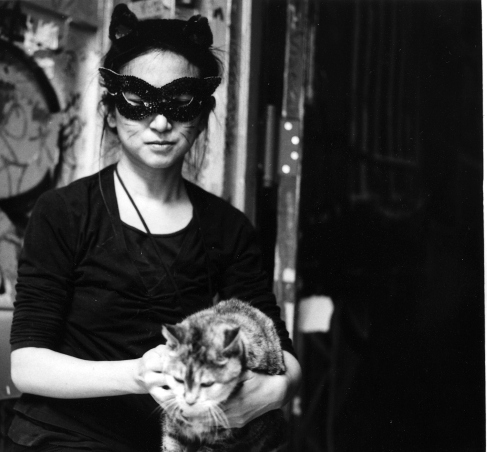
A black & white photo of a person wearing a black shirt and cat mask, holding a fluffy kitty.
Kindly give us a short description of yourself and the work you do.
I do a zine called Tenacious: Art & Writings by Women in Prison which, as its title states, is a compilation of writings & art by women incarcerated across the nation. The zine exists to both give women a platform for their voices and experiences and to educate people outside of prison about the horrors that women face behind bars.
I’ll also be tabling a zine called Enter the 90s: Punks & Poets at ABC No Rio, a partial history of the community arts center in the early 1990s with the beginning of the punk/hardcore shows (now famous–or infamous–for its No Racism/No Sexism/No Homophobia booking policy that was rare in 1990s NYC).
One of these days, I’ll continue my interviews and documentation of No Rio’s history as it’s changed and grown throughout the years, but for now, that’s the part of No Rio’s history I’ll be bringing.
I may also (if it’s okay with the Zinefest organizers) bring a couple of copies of my book Resistance Behind Bars: The Struggles of Incarcerated Women, which examines resistance and organizing in women’s prisons. What is your process for creating/assembling your zines?
Eons ago, when I still had time to do personal zines, I would use cut and paste. I would hand-write or type up text, then cut it out and glue it onto pages along with images I’d either printed out or photocopied.
These days, I simply do everything by computer. For Tenacious, I receive incarcerated women’s writings via snail mail. Most of the time the pieces are handwritten; occasionally, someone has access to a typewriter or word processor and sends me a typed piece. Either way, I still retype it so that it’s all on my computer. Then, when it’s time to compile the zine, I scan the drawings they’ve sent into jpegs, cut and paste everything into a word document, save as a pdf and print. I usually print one to three versions, playing around with the order of pieces until I’m happy with everything. Then I take it to the fantastic Wholesale Copy Shop on 28th Street, drop it off to be copied, walk to the nearby comic book store to kill an hour, come back & pick up my box.
Then begins the long and tedious process of folding and stapling. (I do it myself to keep costs down since I send the zine free to any incarcerated woman who requests it.) I usually put a movie on and half-watch while folding. I’ve learned that, although I love Cantonese movies, it’s really difficult to read the subtitles *and* fold zines properly.
What is your favorite tool or implement for doing so?
A bone folder! My daughter has one from when she used to do origami and occasionally lets me use it. Otherwise, I use a pencil to try to get a sharper crease. What tips or thoughts would you have for folks who want to make a zine but aren’t sure how?
There is no wrong way to make a zine.
But if you want to see different ways that different people make zines, visit the Zine Fest and check out the tables. Talk to the people behind the tables & ask us questions. We’re more than happy to answer.
If you want to see even *more* zines, check out the Barnard Zine Library while you’re at the Zinefest (or make plans to come back another day). Also, check out the ABC No Rio zine library which has over 13,000 (yes, that’s thirteen thousand–not a typo!) zines from the 1980s to now. If you want to see different styles, we can definitely show you different styles!
Do you have a “bad feminist” (a la Roxane Gay) moment? Has your relationship to feminism changed over time?
I think that every parent has a slew of “bad feminist” moments. I’ll have to think about one I’m willing to share and get back to you. Finally, who are some of the other zinesters you’re excited to see at this year’s feminist zine fest?
I am always excited to see China Martens, who is sometimes known as the grandmother of the mama zine. She & I have known each other since 2003 and have been collaborating on & off since then. It is always fantastic to see her.
I’m excited that Black & Pink NYC will be tabling this year. Black & Pink, for those who don’t know, connects people on the outside with LGBTQ penpals inside of prison. They also have an amazing analysis of power, prison, marginalization & criminalization that I hope they expand on for thir Zinester interview.
I’m also happy to see that ABC No Rio’s zine library will be repping again this year. It’s such an amazing resource that often gets overlooked because it’s not part of a huge institution (with huge institutional support).
For folks I’ve never met, I’m intrigued by Donna Choi‘s work and am definitely looking forward to seeing it in person. I have to add, though, that last year, just getting to walk around the tables and meet zinesters in person was amazing and so much more than just perusing their on-line presence. So I’m looking forward to that.
A saturated photo of Jahnny standing with their arms crossed in front of their chest in a short bright skirt and tall black socks.
Kindly give us a short description of yourself and the work you do.
A miserable mixing pot of glam rock, punk rock and anime tween fever, lightly coated in a baby pink slime.
How did you get introduced to zines? Were you influenced by anyone?
In middle school I started getting really into music and the history of the fashion that came with it. I really love Joan Jett and Billy Idol, who were both kinda part of the whole 70s/80s rock and roll scene, and just between them there were amazing album covers and gig posters which lead me to find zines/comics and a more diy attitude. I was also super into manga and anime and started teaching myself to draw based off that style.
What does it mean to do “feminist zine-making”? Does feminism appear in your work (explicitly or implicitly)?
For me and my zine group (HellBitches) it’s just kind of become about girls doing art, that was the original idea. It can be any kind of art: comics, drawings, collage, photos, and just the effort of us keeping the group together and meeting up is what makes it feminist. It’s not meant to be for or against any specific type of girl, it’s just about working together for us.
I never intended to put out a feminist message, I just love having projects to work on. It was about creating something fun for a group of weird chicks in art school. 🙂
What is your favorite zine or piece of mail art? Do you like any specific style/part of a zine?
I can’t really think of a favorite on going zine, but I have a couple of artist penpals and we love just sending each other whatever were working on and just supporting each other with positive cards and messages!
Our next interview is with zinester Maggie Negrete, a.k.a. mgglnt! Read on for musings.
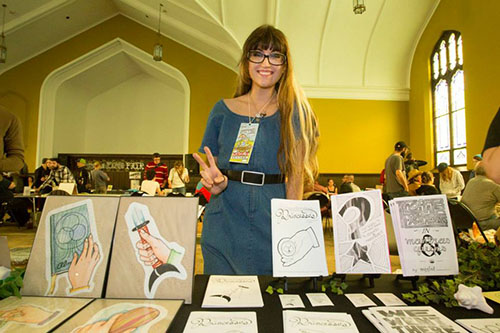
Maggie Negrete, a long blond-haired person wearing glasses, standing behind a row of their zines at a zine fest.
Kindly give us a short description of yourself and the work you do.
I am a native of SW Pennsylvania and Vassar College alum that has pursued far reaching academic interests (chemistry, latin american history, linguistics) but has found myself deeply rooted in my community of Pittsburgh as an artist, educator and community organizer. My work ranges from typography, illustration, and relief printing to installation and graphic design. I love solving problems with my art and helping my students and neighbors actualize their ideas through art-making as well. I feel lucky to teach for MGR Youth Empowerment, to work at the Greater Pittsburgh Arts Council and to organize the Pittsburgh Zine Fair
How did you get introduced to zines? Were you influenced by anyone?
I started making art books in high school and inevitably, someone said the word “ZINE”. It wasn’t until college that I began working on an Anarchist zine at Vassar with the Catalyst working group. This experience was fundamental to my interest in making zines as I saw the impact they had on community organizing and radical info sharing. Nowadays, I find myself surrounded by amazing zinesters: photographers, writers, cartoonists, etc. and have to give a hardy shout out to my local Zine Librarian, Jude Vachon for being the best advocate and steward of zines in Pittsburgh.
What does it mean to do “feminist zine-making”? Does feminism appear in your work (explicitly or implicitly)?
Feminism is a core facet to my art-making and has been since my first independent projects in high school. I am fascinated by the role of womyn in society and how there is often a large dichotomy between their fragile depictions in literature and on screen versus the dynamic womyn I have had in my own life. Oftentimes, my feminism is tied to the occult, especially early paganism/shamanism that acknowledges the strength of female deities and womyn as leaders in their communities. With the rise of Judeo-Christian and patriarchal societies, these spiritualities and mythologies were supplanted and co-opted to favor masculine narratives. Feminist zine-making, in my mind, is tied to the reclamation of the power, the voice and presence of womyn in society that was taken through manipulating history and demonizing feminine power. Womyn need a platform, and zines are the kind of radical vehicle to carry our voices without hindrance.
What is your favorite zine or piece of mail art? Do you like any specific style/part of a zine?
OMG I CAN’T PICK ONE ZINE. I love fancy art-book esque zines and I love cut-n-paste zines all the same. My favorite part of a zine is probably the sheer fact that it exists, that someone had an idea and brought it to life
If you could sum up your zinester life in a kitchen appliance, what appliance would it be?
Casserole Dish.
Finally, who are some of the other zinesters you’re excited to see at this year’s feminist zine fest?
I am excited to finally meet Annie Mok (who was unable at the last minute to come for the Pgh Zine Fair) and to see the work of Sarah Mangle because I love coloring books!!
The Feminist Zine Fest will serve as a satellite location for this year’s Art + Feminism Wikipedia Edit-a-thon. We’ll have one or more experienced Wikipedians on hand to help new and old editors create and improve articles on feminist zine makers and other artists. Zine makers who do not yet have Wikipedia entries:
Cindy Crabb
Daniela Capistrano/The POC Zine Project
Margarita Alcantara (Bamboo Girl)
Nia King
Osa Atoe
You can change that! It’s both easier and harder than you think.
This lovely interview is with the zinester behind Girl Pains, Caroline Tompkins! Take a gander.
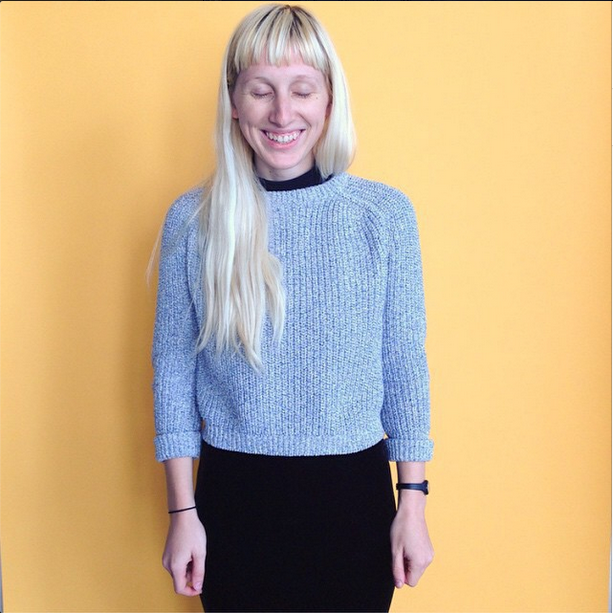
Blond long-haired Caroline with eyes closed stands in front of yellow wall.
Kindly give us a short description of yourself and the work you do.
Born in Cincinnati, OH during the early nineties, I recently received a BFA with Honors in Photography from the School of Visual Arts in New York. My mediums of choice are photographs, Shrinky Dinks, zines, soft sculpture, hard sculpture, dancing and kissing. My work has been featured on the Huffington Post, Al Jazeera America, BBC, and Dazed among others. I currently live in Brooklyn working as an Assistant Photo Editor at Bloomberg Businessweek and Studio Technician at the School of Visual Arts. I try to care as much as I can.
How did you get introduced to zines? Were you influenced by anyone?
I grew up in the punk community in Cincinnati which put an importance on zines that I think is really productive. People were sharing their skills / opinions / self-help treatments / feelings / art all through this outlet and that’s always
been super exciting to me. I’ve always been attracted to the “anyone can do it” approach to making zines.
What does it mean to do “feminist zine-making”? Does feminism appear in your work (explicitly or implicitly)?
Well, I’m a feminist, so I think that’s going to show through in whatever I am making. Making a zine about X-Files may not scream a certain feminist agenda, but when you think about a character like Dana Scully and her relationship to feminism, the connection becomes clear. I like to think my work normalizes feminism in a way that separating it as such is not necessary.
What is your favorite zine or piece of mail art? Do you like any specific style/part of a zine?
It’s so difficult to pick a favorite zine. I really like the work of Caroline Paquita, Andrea Kalfas, Jensine Eckwall, Daniel Zender, Kaye Blegvad, Lizzy Stewart, Got a Girl Crush, Raleigh Briggs, Women Artists, Liz Prince, Ramsey Beyer, and so so so many others I’m sure I’m forgetting. I really like zines that are aesthetically considered and have precious elements.
If you could sum up your zinester life in a kitchen appliance, what appliance would it be?
Let’s be real, I’m an ice cream maker through and through.
Finally, who are some of the other zinesters you’re excited to see at this year’s feminist zine fest?
Gosh so many! I’m stoked on Hazel Newlevant. Her and I went to school together! Always siked to see her doing cool things.





 NYC Feminist Zinefest