Interview with a Zinester: Vikki Law!

Today we’re serving up an interview with returning tabler Vikki Law! You can check out their previous interview here.
VikkiLawPhoto
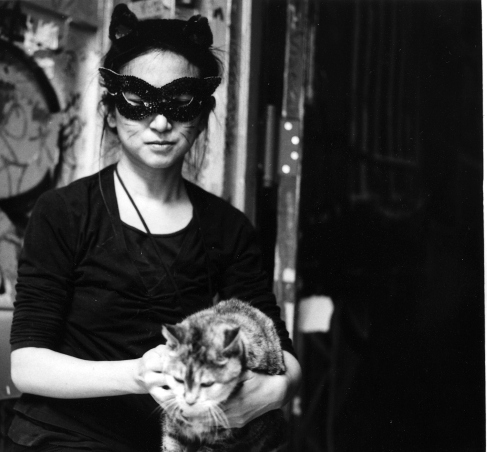
A black & white photo of a person wearing a black shirt and cat mask, holding a fluffy kitty.

Kindly give us a short description of yourself and the work you do.

I do a zine called Tenacious: Art & Writings by Women in Prison which, as its title states, is a compilation of writings & art by women incarcerated across the nation. The zine exists to both give women a platform for their voices and experiences and to educate people outside of prison about the horrors that women face behind bars.

I’ll also be tabling a zine called Enter the 90s: Punks & Poets at ABC No Rio, a partial history of the community arts center in the early 1990s with the beginning of the punk/hardcore shows (now famous–or infamous–for its No Racism/No Sexism/No Homophobia booking policy that was rare in 1990s NYC).

One of these days, I’ll continue my interviews and documentation of No Rio’s history as it’s changed and grown throughout the years, but for now, that’s the part of No Rio’s history I’ll be bringing.

I may also (if it’s okay with the Zinefest organizers) bring a couple of copies of my book Resistance Behind Bars: The Struggles of Incarcerated Women, which examines resistance and organizing in women’s prisons.
What is your process for creating/assembling your zines?

Eons ago, when I still had time to do personal zines, I would use cut and paste. I would hand-write or type up text, then cut it out and glue it onto pages along with images I’d either printed out or photocopied.

These days, I simply do everything by computer. For Tenacious, I receive incarcerated women’s writings via snail mail. Most of the time the pieces are handwritten; occasionally, someone has access to a typewriter or word processor and sends me a typed piece. Either way, I still retype it so that it’s all on my computer. Then, when it’s time to compile the zine, I scan the drawings they’ve sent into jpegs, cut and paste everything into a word document, save as a pdf and print. I usually print one to three versions, playing around with the order of pieces until I’m happy with everything. Then I take it to the fantastic Wholesale Copy Shop on 28th Street, drop it off to be copied, walk to the nearby comic book store to kill an hour, come back & pick up my box.

Then begins the long and tedious process of folding and stapling. (I do it myself to keep costs down since I send the zine free to any incarcerated woman who requests it.) I usually put a movie on and half-watch while folding. I’ve learned that, although I love Cantonese movies, it’s really difficult to read the subtitles *and* fold zines properly.

What is your favorite tool or implement for doing so?

A bone folder! My daughter has one from when she used to do origami and occasionally lets me use it. Otherwise, I use a pencil to try to get a sharper crease.
What tips or thoughts would you have for folks who want to make a zine but aren’t sure how?

There is no wrong way to make a zine.

But if you want to see different ways that different people make zines, visit the Zine Fest and check out the tables. Talk to the people behind the tables & ask us questions. We’re more than happy to answer.

If you want to see even *more* zines, check out the Barnard Zine Library while you’re at the Zinefest (or make plans to come back another day). Also, check out the ABC No Rio zine library which has over 13,000 (yes, that’s thirteen thousand–not a typo!) zines from the 1980s to now. If you want to see different styles, we can definitely show you different styles!

Do you have a “bad feminist” (a la Roxane Gay) moment? Has your relationship to feminism changed over time?

I think that every parent has a slew of “bad feminist” moments. I’ll have to think about one I’m willing to share and get back to you.
Finally, who are some of the other zinesters you’re excited to see at this year’s feminist zine fest?

I am always excited to see China Martens, who is sometimes known as the grandmother of the mama zine. She & I have known each other since 2003 and have been collaborating on & off since then. It is always fantastic to see her.

I’m excited that Black & Pink NYC will be tabling this year. Black & Pink, for those who don’t know, connects people on the outside with LGBTQ penpals inside of prison. They also have an amazing analysis of power, prison, marginalization & criminalization that I hope they expand on for thir Zinester interview.

I’m also happy to see that ABC No Rio’s zine library will be repping again this year. It’s such an amazing resource that often gets overlooked because it’s not part of a huge institution (with huge institutional support).

For folks I’ve never met, I’m intrigued by Donna Choi‘s work and am definitely looking forward to seeing it in person. I have to add, though, that last year, just getting to walk around the tables and meet zinesters in person was amazing and so much more than just perusing their on-line presence. So I’m looking forward to that.

Interview with a Zinester: Jahnny Vommit!

Jahnny Vommit brings us the next interview – connect with them more over at their website and/or follow them on Instagram!

A saturated photo of Jahnny standing with their arms crossed in front of their chest in a short bright skirt and tall black socks.

Kindly give us a short description of yourself and the work you do.

A miserable mixing pot of glam rock, punk rock and anime tween fever, lightly coated in a baby pink slime.

How did you get introduced to zines? Were you influenced by anyone?

In middle school I started getting really into music and the history of the fashion that came with it. I really love Joan Jett and Billy Idol, who were both kinda part of the whole 70s/80s rock and roll scene, and just between them there were amazing album covers and gig posters which lead me to find zines/comics and a more diy attitude. I was also super into manga and anime and started teaching myself to draw based off that style.

What does it mean to do “feminist zine-making”? Does feminism appear in your work (explicitly or implicitly)?

For me and my zine group (HellBitches) it’s just kind of become about girls doing art, that was the original idea. It can be any kind of art: comics, drawings, collage, photos, and just the effort of us keeping the group together and meeting up is what makes it feminist. It’s not meant to be for or against any specific type of girl, it’s just about working together for us.

I never intended to put out a feminist message, I just love having projects to work on. It was about creating something fun for a group of weird chicks in art school. 🙂

What is your favorite zine or piece of mail art? Do you like any specific style/part of a zine?

I can’t really think of a favorite on going zine, but I have a couple of artist penpals and we love just sending each other whatever were working on and just supporting each other with positive cards and messages!

I’ll name drop some of my good friends 🙂

Sally : http://inkanddestroy.tumblr.com

June: http://junerevolver.tumblr.com

Kendra: http://artbywannabeanarchist.tumblr.com

Fave part of a zine is definitely any cool collage stuff or short comics!

If you could sum up your zinester life in a kitchen appliance, what appliance would it be?

It would have to be a hot pink kitchen aid mixer!

Finally, who are some of the other zinesters you’re excited to see at this year’s feminist zine fest?

I’m really excited to see ABC No Rio at the zine fest! I’ve played a few show with them so they hold a special place in my heart)!

Interview with a Zinester: Maggie Negrete!

Our next interview is with zinester Maggie Negrete, a.k.a. mgglnt! Read on for musings.

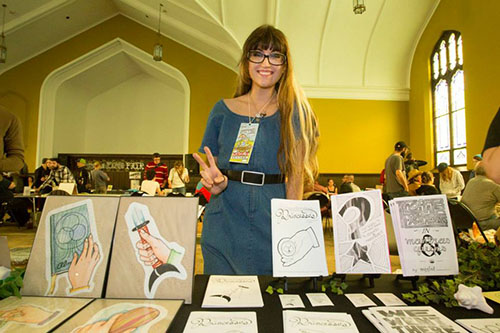
Maggie Negrete, a long blond-haired person, standing behind a row of their zines at a zine fest.
Maggie Negrete, a long blond-haired person wearing glasses, standing behind a row of their zines at a zine fest.

Kindly give us a short description of yourself and the work you do.

I am a native of SW Pennsylvania and Vassar College alum that has pursued far reaching academic interests (chemistry, latin american history, linguistics) but has found myself deeply rooted in my community of Pittsburgh as an artist, educator and community organizer. My work ranges from typography, illustration, and relief printing to installation and graphic design. I love solving problems with my art and helping my students and neighbors actualize their ideas through art-making as well. I feel lucky to teach for MGR Youth Empowerment, to work at the Greater Pittsburgh Arts Council and to organize the Pittsburgh Zine Fair

How did you get introduced to zines? Were you influenced by anyone?

I started making art books in high school and inevitably, someone said the word “ZINE”. It wasn’t until college that I began working on an Anarchist zine at Vassar with the Catalyst working group. This experience was fundamental to my interest in making zines as I saw the impact they had on community organizing and radical info sharing. Nowadays, I find myself surrounded by amazing zinesters: photographers, writers, cartoonists, etc. and have to give a hardy shout out to my local Zine Librarian, Jude Vachon for being the best advocate and steward of zines in Pittsburgh.

What does it mean to do “feminist zine-making”? Does feminism appear in your work (explicitly or implicitly)?

Feminism is a core facet to my art-making and has been since my first independent projects in high school. I am fascinated by the role of womyn in society and how there is often a large dichotomy between their fragile depictions in literature and on screen versus the dynamic womyn I have had in my own life. Oftentimes, my feminism is tied to the occult, especially early paganism/shamanism that acknowledges the strength of female deities and womyn as leaders in their communities. With the rise of Judeo-Christian and patriarchal societies, these spiritualities and mythologies were supplanted and co-opted to favor masculine narratives. Feminist zine-making, in my mind, is tied to the reclamation of the power, the voice and presence of womyn in society that was taken through manipulating history and demonizing feminine power. Womyn need a platform, and zines are the kind of radical vehicle to carry our voices without hindrance.

What is your favorite zine or piece of mail art? Do you like any specific style/part of a zine?

OMG I CAN’T PICK ONE ZINE. I love fancy art-book esque zines and I love cut-n-paste zines all the same. My favorite part of a zine is probably the sheer fact that it exists, that someone had an idea and brought it to life

If you could sum up your zinester life in a kitchen appliance, what appliance would it be?

Casserole Dish.

Finally, who are some of the other zinesters you’re excited to see at this year’s feminist zine fest?

I am excited to finally meet Annie Mok (who was unable at the last minute to come for the Pgh Zine Fair) and to see the work of Sarah Mangle because I love coloring books!!

Interview with a Zinester: Caroline Tompkins!

This lovely interview is with the zinester behind Girl Pains, Caroline Tompkins! Take a gander.

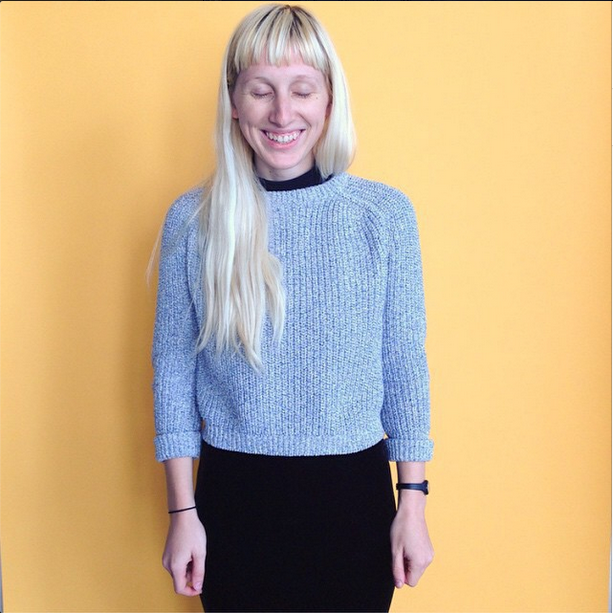
Blond long-haired Caroline with eyes closed stands in front of yellow wall.

Kindly give us a short description of yourself and the work you do.

Born in Cincinnati, OH during the early nineties, I recently received a BFA with Honors in Photography from the School of Visual Arts in New York. My mediums of choice are photographs, Shrinky Dinks, zines, soft sculpture, hard sculpture, dancing and kissing.  My work has been featured on the Huffington Post, Al Jazeera America, BBC, and Dazed among others. I currently live in Brooklyn working as an Assistant Photo Editor at Bloomberg Businessweek and Studio Technician at the School of Visual Arts. I try to care as much as I can.

How did you get introduced to zines? Were you influenced by anyone?

I grew up in the punk community in Cincinnati which put an importance on zines that I think is really productive. People were sharing their skills / opinions / self-help treatments / feelings / art all through this outlet and that’s always
been super exciting to me. I’ve always been attracted to the “anyone can do it” approach to making zines.

What does it mean to do “feminist zine-making”? Does feminism appear in your work (explicitly or implicitly)?

Well, I’m a feminist, so I think that’s going to show through in whatever I am making. Making a zine about X-Files may not scream a certain feminist agenda, but when you think about a character like Dana Scully and her relationship to feminism, the connection becomes clear. I like to think my work normalizes feminism in a way that separating it as such is not necessary.

What is your favorite zine or piece of mail art? Do you like any specific style/part of a zine?

It’s so difficult to pick a favorite zine. I really like the work of Caroline Paquita, Andrea Kalfas, Jensine Eckwall, Daniel Zender, Kaye Blegvad, Lizzy Stewart, Got a Girl Crush, Raleigh Briggs, Women Artists, Liz Prince, Ramsey Beyer, and so so so many others I’m sure I’m forgetting. I really like zines that are aesthetically considered and have precious elements.

If you could sum up your zinester life in a kitchen appliance, what appliance would it be?

Let’s be real, I’m an ice cream maker through and through.

Finally, who are some of the other zinesters you’re excited to see at this year’s feminist zine fest?

Gosh so many! I’m stoked on Hazel Newlevant. Her and I went to school together! Always siked to see her doing cool things.

Interview with a Zinester: From the Root Zine!

This interview is with the wonderful editors of From the Root, “a Canadian zine dedicated to showcasing writing and art work by women of colour and Indigenous women.” Read on for words from Whitney French, Josiane Anthony H., and Medgine Mathurin!

FromtheRooteditors_whitney
Editor Whitney holding up an issue of From the Root.

Kindly give us a short description of yourself and the work you do.

We are From the Root Zine, a Canadian zine dedicated to showcasing writing and art work by women of colour and Indigenous women navigating through this land called Canada in the skin they are in. From the Root Zine seeks to counteract the lack of publications from authors and visual artists of colour in literary magazines and gallery spaces. Although taking the form of a zine, From the Root attempts to stand out beyond the cut and paste tradition of DIY zines and bridge the gap between a punk zine aesthetic and the so-called prestigious literary journal.

How did you get introduced to zines? Were you influenced by anyone?

Good question. We are new zinesters, so we came to understand zines semi-recently. It’s hard to pin-point the first zine moment, but zines made their way on our radar through a natural hunger for reading. From the Root Zine is heavily inspired by the classic Evolution of a Race Riot by Mimi Thi Nyguen, a monster of a compilation by WOC who dissect the riot grrrl scenes in the US. We wanted something that reflected the unique experiences for WOC in Canada.

FromtheRooteditors_josiane
Editor Josiane holding up an issue of From the Root.

What does it mean to do “feminist zine-making”? Does feminism appear in your work (explicitly or implicitly)?

“Feminist Zine Making” means putting female voices at the forefront. From the Root is intentionally here for women of colour, period. Many times people’s definitions of feminism excludes such perspectives. To us, its impossible to address feminism without talking about the intersectionality of race, ethnicity, (dis)ability, status, sexuality, it just doesn’t work. Marginalization is marginalization no matter how radical people think they are. So feminist zine making mean inclusivity at all costs, without tokenism or water-downed representation.

What is your favorite zine or piece of mail art? Do you like any specific style/part of a zine?

Favourite zine is a tough one! Obviously we are big fans of Evolution of a Race Riot, but we also love big boots, truly our first experience with Canadian zines for and by (trans)women of colour, Sea Witch by Clemetine Morrigan, Existenz by Hoda, another classic FIRE!! Devoted Younger Negro Artists, featuring Langston Hughes and Zora Neale Hurston, which is truly at the root of our literary-meets-zine manifesto. Umm there’s also Margins Zine, Impossibles on Blackness, and I know I’m missing someone. OMG of course MIXD: A Mixed Race Compilation Zine edited by Cinder. There are others, but its a start.

FromTheRooteditor_medgine
Editor Medgine holding up an issue of From the Root.

If you could sum up your zinester life in a kitchen appliance, what appliance would it be?

We are an oven. We take the raw materials, heat things up, HOT, HOT, HOT! then with time and patience (sometimes more time than we anticipate) we bake the goods. We are an oven for sure.

Finally, who are some of the other zinesters you’re excited to see at this year’s feminist zine fest?

Taken Spaces: Black Lesbians Against White Aesthetics is kinda like our US sheros. We’ve been admiring their work from a far and we hope to meet the people behind the work. We’re also huge fans of Bluestockings, the first bookstore to hold our zine (big up!), they do incredible work. Tenacious Zine looks beyond radical and we’re about empowering women writers in prison so they’d be great folks to meet.

Interview with a Zinester: Katherine Arnoldi!

Katherine Arnoldi was kind enough to provide us with the material for this next interview – check out their rad artwork and answers below!

Drawing of a long-haired parent holding a baby in swaddling.

Kindly give us a short description of yourself and the work you do.

I created a cartoon zine of the story of my struggle to go to college as a teenage mother and copied and compiled it for many years, handing it, along with FAFSA forms and college applications, out at the Charas Community Center on the Lower East Side, where I had a “Single Mom College Program” in the early 90’s. I had a library of college guides, SAT Prep books and many other resources at Charas. We, Chino and the late Armando and others from Charas, often went to neighborhood street fairs where I also passed out the zine and materials.  I also took the zine, FAFSA forms and applications to GED programs, neighborhood centers and homeless shelters. The Amazing True Story of a Teenage Single Mom was picked up and published by Hyperion in 1998 as a graphic novel. It will soon be re-printed by Greymalkin Press. I also make other zines, Thanks, Mom and one about globalization issues, Clara Comes Down to Earth. I am always drawing.

How did you get introduced to zines? Were you influenced by anyone?

When I started making my zine, I did not know of other work, though I was later inspired by the cartoonists on the Lower East Side where I lived, such as David Sandlin, Seth Tobacman, James Romberger, Margaurite Van Cook, Sabrina Jones (WW3 and Girl Talk) and many others. I was happy to be included in many WW3 issues. Later I learned of China Marten’s The Future Generation, Trina Robbins (Mama Dramas) and Joyce Farmer’s (Tits and Clits) work in California. Trina Robbins included my work in a show and book, Women Cartoonists of the U.S., which traveled throughout Europe and I met other great cartoonists such as Posy Simmonds from London. I also knew of Art Spiegelman’s Maus, though I did not read it until many years after my graphic novel was published.

What does it mean to do “feminist zine-making”? Does feminism appear in your work (explicitly or implicitly)?

The Amazing True Story of a Teenage Single Mom just simply tells one story but it certainly shows that young mothers often have difficulty finding and maintaining equal access to education. For example, in New York City, there are 11,000 new teenage mothers every year, but the LYFE program for child care at New York City high schools cannot serve anywhere close to all who need it.

Finally, who are some of the other zinesters you’re excited to see at this year’s feminist zine fest?

I am hoping to see China Martens with a new issue of Future Generation and Victoria Law with Tenacious: Art and Writing from Women in Prison at the Feminist Zinefest this year.

Interview with a Zinester: Cam!

Montreal-based Cam gives us our next interview with a zinester (and textile artist)!

CamPhoto
Photo of a person’s torso and legs wearing leopard print shoes on icy ground holds a bucket with a leopard print strip of tape and a pink-bristled broom.

Kindly give us a short description of yourself and the work you do.

I am a textile artist and I live in Montreal (unceded Kanien’kehà:ka & Algonquin territories), Canada. My work is focused on feminist street art, indigenous resistance and decolonization. I am part of the mother daughter duo called Angora (angoramontreal.weebly.com). We realize textiles projects and installations (knitting and sewing). Recycled materials and environmental issues are very important for us, is a form of social and politic engagement.  I’m also one of the organizer of Decolonizing Street Art : Anticolonial Street Artists Convergence (decolonizingstreetart.com). This project fosters the idea of bringing together street artists of indigenous and settler origins and build an artistic community of shared anticolonial values. Finally, I study art history and women’s studies.

How did you get introduced to zines? Were you influenced by anyone?

I was introduced to zines by collecting comics. After that, I became interested illustrators, small press and I started going to zines fairs. We have an important small press fair in Montreal called Expozine with a lot of nice zinesters but my favorite zine fair is the Montreal Anarchist bookfair.

What does it mean to do “feminist zine-making”? Does feminism appear in your work (explicitly or implicitly)?

I think the feminist zines give a voice to the marginalized and racialized people and also to focus on political issues that are invisibilized. For example, I participated in the OFF MuralEs zine (offmurales.tumblr.com) which allowed the feminist street artists to express themselves, including on sexism in street art scene in Montreal. I think feminism appear explicitly and implicitly in my work! I reappropriate a medium (sewing) that was associated with the private sphere to affirm my feminist and political messages in the street.

What is your favorite zine or piece of mail art? Do you like any specific style/part of a zine?

The first zines that I’ve read are those of the artist Julie Doucet. Recently I fell in love with Dumb, Georgia Webber’s zines series. I love zines about anxiety, friendship, graffiti / street art, decolonizing relationships, social class issues and Indigenous struggles. I also like to collect mini zines!

If you could sum up your zinester life in a kitchen appliance, what appliance would it be?

My smoothie mixer that I use every morning. Fresh and powerful!

Finally, who are some of the other zinesters you’re excited to see at this year’s feminist zine fest?

Honestly, I’m so excited to see all the zinesters because it’s my first time at the feminist zine fest!

Interview with a Zinester: Rachel Davies!

Our next interview is with founding editor of Pop Culture Puke, Rachel Davies! Check out their website here.

Rachel Davies, blond and with square black-framed glasses, looks away from the camera.
Rachel Davies,  a brunette with large-framed glasses, looks away from the camera at an eatery.

Kindly give us a short description of yourself and the work you do.

My name is Rachel Davies and I edit Pop Culture Puke, a zine and website. When I founded Pop Culture Puke I envisioned it as a space for young women to discuss pop culture in a way that doesn’t trivialize it. Although certain articles still involve this original conception, PCP has evolved as we now have a broad range of work including poetry, personal essays, photography, etc.

How did you get introduced to zines? Were you influenced by anyone?

I was introduced to zines my then favourite comic book artist posted links to his zines to Tumblr. I began buying zines on Etsy, but didn’t really think about making my own until reading a Rookie article about it. I began making my own lil’ zines of screenshots from Hey Arnold and quotes from my favourite books after that, but Pop Culture Puke is the first zine that I’ve made with a purpose.

What does it mean to do “feminist zine-making”? Does feminism appear in your work (explicitly or implicitly)?

In my opinion, feminist zine-making is about empowering other women through supporting their art and creativity. Feminism appears implicitly in Pop Culture Puke.

What is your favorite zine or piece of mail art? Do you like any specific style/part of a zine?

It’s really difficult to pick a favourite zine! I just read the fifth issue of Filmme Fatales and I’d have to say that that’s my favourite zine right now. I’ve only had it for a week but I’ve reread it a couple times already. There is an even balance of writing and illustration in the zine, which is what I try to focus on when editing Pop Culture Puke.

If you could sum up your zinester life in a kitchen appliance, what appliance would it be?

The appliance would have to be a blender! I think that collaborating on a project, mixing different perspectives together, is a lot more gratifying than doing a project on my own. As I mentioned earlier, I’ve worked on zines on my own but I’ve never felt nearly as proud of those zines as I do of Pop Culture Puke.

Finally, who are some of the other zinesters you’re excited to see at this year’s feminist zine fest?

I don’t know many of the zinesters at this year’s feminist zine fest so I am excited to see everyone, but particularly Suburban Blight, Sy Abudu of Slash Zine, and Caroline Tompkins.

Interview with a Zinester: Nyxia Grey!

Next up to bat for our rad zinester interviews is Nyxia Grey! After you’ve read Nyxia’s responses, you can check out their zines over at their Etsy shop or get in touch at everythingisfinezine@gmail.com.

Nyxia holding up a black and white cat as another black furry creature walks out of frame.

Kindly give us a short description of yourself and the work you do.

I am a research librarian and the zine librarian at a small liberal arts college for women. I write a perzine called “Everything.is.Fine.” which addresses feminism, body politics, eating disorders and recovery, taking up space, sexual consent, grief, and other ramblings from my life. I also create collages, write poetry and short stories, make magickal candles, and construct jewelry made from Salem, MA beach glass. I am active in the Violence Prevention and Educational Outreach community at the college, work closely with Sociology and Women and Gender Studies students, lead a zine group called “To the Front” that focuses on craftivism and zines, and do workshops around campus on the power of zines.

How did you get introduced to zines? Were you influenced by anyone?

I was first introduced to zines around 1993 with the zine “The I hate Brenda Newsletter” by Deborah Romeo. It totally blew my mind that someone (a girl!) could write what they felt and disseminate it. I started my own zine called “Smashed Louie” junior year of high school and was promptly suspended from school senior year for disseminating it. All this experience really did was prove to me that not only were zines powerful, but that a girl’s voice could institute change. I have been creating zines on and off since that time.

What does it mean to do “feminist zine-making”? Does feminism appear in your work (explicitly or implicitly)?

Feminism is in everything I do and create. ‘Feminist zine-making’ for me is the creation of space where feminists (all genders) can feel safe and inspired to discuss and explore the world around them, to produce work that reflects all forms of protest against the patriarchy and –isms, and also to provide an avenue for gender equality to flourish. It might start simply in print but my dream is that one day soon that ink will bleed over into the physical world around us.

What is your favorite zine or piece of mail art? Do you like any specific style/part of a zine?

Pinning down a favorite zine is like asking me what my favorite song is! It cannot be done. My current ‘favorite’ totally depends on where my headspace is at. Some zines that have really impacted my life in a positive way are “ANAlog: dispatches of d.i.y. anorexia recovery” by Ponyboy Violet, “Brainscan 21: irreconcilable differences” by Alex Wrekk, “Piece #6: on commuting” by Nichole, and “All I Want is Everything” by Caitlin.

The zines I most enjoy reading are perzines simply because I like the intimate connection that is formed between creator and reader. It is such a unique experience that is only really found in this medium. I know firsthand that you can literally read your way to healing by stepping into these intimate written spaces.

If you could sum up your zinester life in a kitchen appliance, what appliance would it be?

The first thing that came to mind was my Soda Stream. I like taking something and infusing it with my own creativity to make it something different. Not necessarily better but enhanced, hyped up, jazzed. I approach my writing and collage work in this way. How can I take an idea, a thought, a feeling, and amp it up so that it has more power, more of an impact. How can I turn this into frizzante that compliments all that I represent.

Finally, who are some of the other zinesters you’re excited to see at this year’s feminist zine fest?

Jenna Freedman, Kate Larson, Emma Karin, and Joyce Hatton. The zines produced by their zinesters have been used in a few of the classes I do workshops for in Sociology and Women and Gender Studies. It will be rad to finally meet them.