News

Community Agreements

New York City Feminist Zine Fest Community Agreements

Have Fun!

We invite you to have a good time and meet each other.
Challenge Your Participation

Challenge yourself to speak up/participate more or move up by making room for others to speak/participate more.

**Respect people’s names and pronouns at all times

**Oppression is real and exists

Most of us in the room have and/or are currently experiencing oppression. As we share this space we will work against oppressing one another.

We all make mistakes and hold each other accountable.

If someone says something that feels hurtful or offensive, we encourage you to acknowledge what just happened. If you have said something that was offensive or hurtful to someone, we encourage you to acknowledge what just happened.

Check your responses/Gauge your reactions

If something comes up during a discussion or activity that you find hard or difficult, try sitting with that feeling to better gauge how you’d like to respond.

**Respect people’s physical boundaries and personal space at all times

Please do not touch people or their belongings without the consent of the person (even hugs!). No physical violence or threats of violence of any kind will be tolerated.

**Even if your intentions are well meaning, please do not ask someone what their “old name” was or if they are trans, gender nonconforming, or intersex.

Barnard College has unfortunately had a long history of transmisogyny (prejudice against trans women) and we want NYC Feminist Zine Fest to challenge that, not replicate it. It is up to the individual whether or not they want to offer up that kind of information.

Take care of yourself/Take care of your needs

Please don’t hesitate to ask if you need any assistance.

**Please respect the space

We are all responsible for throwing away our own garbage and recycling and cleaning up any mess. Please don’t hesitate to ask if you need any assistance. Damaging or destroying any equipment, materials, or building property is not allowed.

**If you choose not to respect this group agreement, you may be asked to leave.

derived from the Sylvia Rivera Law Project

Acuerdos de la Comunidad

¡Divertirse!

Te invitamos a pasar un buen rato y conocer a los demas.

Ponte a prueba su participación

Ponte a prueba de hablar/participar más o ascender al hacer sitio a otros para hablar/participar más.

**Respetar los nombres y los pronombres de la gente en todo momento.

**La opresión es real y existe

La mayoría de nosotros en el espacio tienen y/o actualmente estan experimentando opresion. Al compartir este espacio vamos a trabajar contra la opresión entre unos a otros.

Todos cometemos errores y sostenemos mutuamente responsables

Si alguien dice algo que se duele o se siente es ofensivo, le animamos reconoce lo que sucede. Si ha dicho algo que era ofensivo o se duele alguien, te animamos reconoce lo que sucede.

Compruebe sus respuestas/Mida sus reacciones

Si algo sucede durante una discusión o actividad que usted se siente es difícil, trate de estar con esa sensación de mejor medir cómo desea responder.

**Respetar los límites físicos de las personas y el espacio personal en todo momento

Por favor, no toca a las personas o sus pertenencias sin el consentimiento de la persona (incluso abrazos!). La violencia física o amenazas de violencia de cualquier tipo no será tolerado.

**Aunque sus intenciones son buenas intenciones, por favor, no pedir a alguien lo que era su “nombre antiguo” o si son trans, de genero no conforme, o intersex.

Barnard College ha tenido por desgracia una larga historia de la misoginia trans (los prejuicios contra las mujeres trans) y queremos que el Zine Fest Feminista de NYC desafiar eso, no replicarlo. Depende de la persona si quieren ofrecer ese tipo de información.

Cuida de ti mismo/Cuide sus necesidades

No dude en conseguir comida y beber, ir al baño, estirar o tomar descansos en cualquier momento. Por favor, no dude en preguntar si necesita ayuda.

**Por favor, respeten el espacio

Todos somos responsables de tirar nuestra basura y reciclaje y limpieza de cualquier espacio desordenado. Por favor, no dude en preguntar si necesita ayuda. No se permite dañar o destruir cualquier equipo de oficina, materiales o propiedad del edificio.

**Si decide no respetar este acuerdo de la comunidad, es posible que se le pida que deje.

Interview with a Zinester: Kesheena!

Kesheena of Going Places zine has our hearts for the next interview. Check it out!

Kesheena, wearing a red shirt with white polka dots, looks to the right against a tan wall.
Kesheena, wearing tattoos, a white bead necklace, and a red shirt with white polka dots, looks to the right.

Kindly give us a short description of yourself and the work you do.

I write an on-going zine, entitled Going Places, that focuses on my life as a Navajo punk, Native American diaspora, and other self-interests. I hope that with my zine, I can break down stereotypes about what a Native American is supposed to be and also encourage other Natives to express themselves.

How did you get introduced to zines? Were you influenced by anyone?

My older brother had a bunch of issues of CHAOS, a local punk zine lying around the house, and I started reading them when I got into punk. I bought my first zine at 13 at my second or third show and things took off from there. I got addicted to zines and have been reading them ever since. I think my favorite’s are Alex Wrekk’s Brainscan and Dave Roche’s On Subbing, though I also have to give a huge shoutout to WOC Zine group in Portland who inspired me to start making zines.

What does it mean to do “feminist zine-making”? Does feminism appear in your work (explicitly or implicitly)?

Feminist zine-making would articulate the saying, “the personal is political.” Though I don’t necessarily consider my work feminist, I think there are many elements that would make it feminist.

What is your favorite zine or piece of mail art? Do you like any specific style/part of a zine?

I like per-zine’s the most, but honestly I enjoy any zine style. Every zine I’ve read has given me something.

If you could sum up your zinester life in a kitchen appliance, what appliance would it be?

I’m gonna go with a crockpot. It takes me a long time to create a zine, from ideas to layouts. (I’ve been researching and working on one for over 2 years now!)

Finally, who are some of the other zinesters you’re excited to see at this year’s feminist zine fest?

I can’t wait to see all the zinesters. This is my first zine fest outside of Portland and my first zine fest where I’m tabling at.

Interview with a Zinester: The Wheelhouse!

The Wheelhouse is up next — we’re getting super close to the fest and we’re excited to meet everyone! Hope you are too 🙂

Two of The Wheelhouse zinesters, Lauren and Aus, posing behind an empty ornate black frame.

Kindly give us a short description of yourself and the work you do.

Lauren Melissa writes zines about being a queer, fat, intersectional fem(me)inist. Aus Bahadur is a queer, brown, intersectional feminist who tries to make art about survival, mental health, and the encroaching doom that awaits us all. Together they run The Wheelhouse – a Toronto-based supporting resource with an intersectional approach to social justice.

(we are going to tag-team the rest of this interview, like tough lady wrestlers)

How did you get introduced to zines? Were you influenced by anyone?

Lauren: I started attending zine fairs before I got the courage to make one – I think the Toronto Queer Zine Fair was one of my first experiences and I fell in love with all of the awesome art and writing! I actually picked up a zine that had a drawing of Aus in it (this was at the beginning of our clumsy/nerdy courtship and I totally used it as an excuse to send him a message). He’s the one who actually convinced me that I could make my own zines and I debuted the first issue of BigFatFemme at the Philly Feminist Zine Fest in 2014 (by debuted, I mean we spent most of the day at Staples and made it to the fest for the last hour, but whatever, I call it a win!). The night before, our friend Khristina handed me a bone folder and I no idea what it was (now I’m slightly more cool and know what it’s for but still haven’t used one).

What does it mean to do “feminist zine-making”? Does feminism appear in your work (explicitly or implicitly)?

Aus: In the words of someone far more eloquent (bell hooks), “Individuals who fight for the eradication of sexism, without struggles to end racism or classism undermine their own efforts. Individuals who fight for the eradication of racism or classism, while supporting sexist oppression are helping to maintain the cultural basis of all forms of group oppression.” The art we create challenges not only gender-based oppression but also the racist and classist structures that limit us as individuals and as a community. Our feminism moves beyond a single issue framework because the issues of the marginalized are complex and interwoven.

What is your favorite zine or piece of mail art? Do you like any specific style/part of a zine?

Lauren: I am a big fan of perzines – they hit me right in the feels and make me think deep thoughts. Some of my favourite zines are Motor City Kitty By Brianna Dearest, Tributaries by JC, What to Keep, What to Give Away by Khristina Acosta, Sea Witch by Clementine Morrigan, Radical Domesticity by Emma Karin Eriksson, My Anxiety, My Lover by Joyce Hatton and SO MUCH MORE!

Also, one time I got a zine where the artist (Melanie Gillman) used duct tape to bind it and I fell in love – I’m a big fan of fancy duct tape and now that’s how I finish off my copies of Fat Babes to Make You Smile 🙂

If you could sum up your zinester life in a kitchen appliance, what appliance would it be?

Aus: a solid metal, vintage, hand cranked egg beater (like my mom used to have) because it’s practical, reliable, sometimes messy, and stylish as fuck.

Finally, who are some of the other zinesters you’re excited to see at this year’s feminist zine fest?

We’re excited to see all of our zine pals (JC, Sarah Sawyers-Lovett, Emma Karin Eriksson, Joyce Hatton, Nicole Harring, Elvis Wolf) and make a bunch of new ones!!

Interview with a Zinester: Tale of the Gray Wolf!

Next up we’re excited to have some words from Tale of the Gray Wolf!

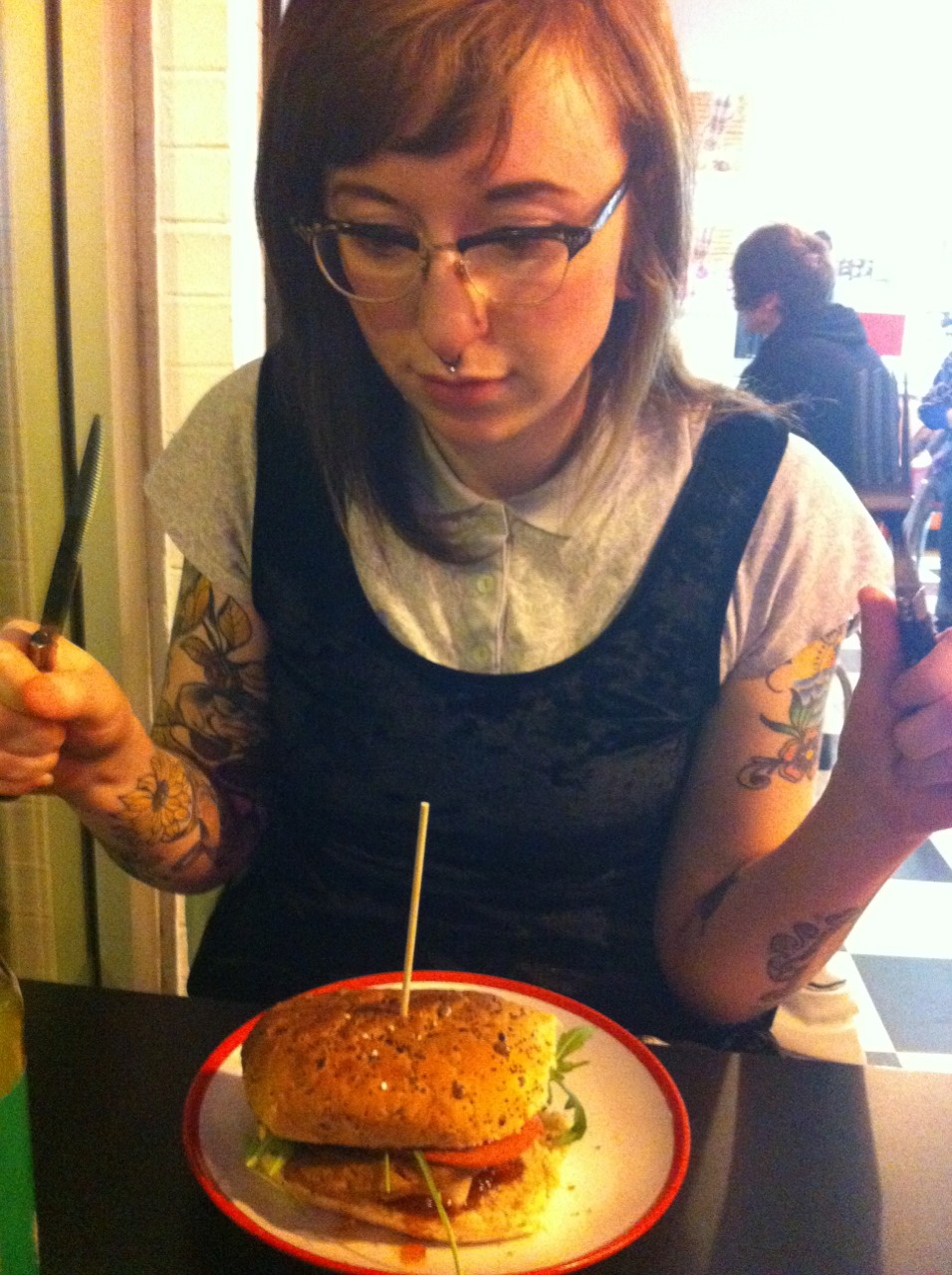
Photo of zinester for Tale of the Gray Wolf with fork and knife in hand, about to dig into a burger.

Kindly give us a short description of yourself and the work you do.

I am a vegan, queer-identifying human who grew up in the UK but is currently living in Toronto, Canada with my cat Pickle. I constantly like to have something creative going and regularly make zines and patches under Tale Of The Gray Wolf, and soap and other body products under Speckled Fawn Soaps. My content with Tale Of The Gray Wolf tends to reflect whatever I am feeling passionate about, including queerness, feminism, mixed race issues, animals etc.

How did you get introduced to zines? Were you influenced by anyone?

I first discovered zines a few years back when a friend had some in their house. I read a few and found it really interesting to have a peek into the lives of the people that wrote them. I later attended a couple of zine events in the UK and realised there was no limit to what you could make them about, and that anyone could do it! As for influences, I feel like I am constantly being influenced by so many people. A lot of my friends both in Toronto and the UK make zines and it’s really inspiring and motivating to see others being creative around you.

What does it mean to do “feminist zine-making”? Does feminism appear in your work (explicitly or implicitly)?

To me, feminism is just one way of working towards many oppressions we need to fight against. I try and cover all kinds of anti-oppressive politics in my zines, and much of what I write about is to do with what I have learnt over time, such as understanding the individual circumstances of others in my life and the struggles they may feel, as well as communicating my own, and I feel like these are key parts of a feminist attitude.

What is your favorite zine or piece of mail art? Do you like any specific style/part of a zine?

It is very difficult to pick one favourite zine, so I’m just going to say that I really appreciate everyone who puts something personal out there, something they might be afraid to put into words but are brave enough to do so anyway. I find it so inspiring to read about those who are expressing their deepest feelings and passions

If you could sum up your zinester life in a kitchen appliance, what appliance would it be?

Probably a slow cooker. It often takes me a while to process my thoughts and turn them into something creative, but I feel really accomplished when I have taken the time to get something finished in the way I want.

Finally, who are some of the other zinesters you’re excited to see at this year’s feminist zine fest?

I’m excited to be tabling alongside fellow Torontonians The Wheelhouse, as well as catching up with Sarah of How Are Your Insides who I met recently at LA Zine Fest. Otherwise, I am still relatively new to this side of the world so I can’t wait to meet new people and discover all of the awesome work that they do!

Interview with a Zinester: Sy Abudu!

We’re getting super close! As the date comes nearer, check out our next fab interview with Sy Abudu, who you can also find on Tumblr or at their website.

B&w photo of Sy looking down at a book amidst book-filled shelves.

Kindly give us a short description of yourself and the work you do.

I’m an Angeleno turned Brooklynite who works as a multimedia producer in higher ed. My zines and visual art center around found images of African-Americans. I scour everywhere from the Library of Congress to Etsy to my family’s own photo albums to find the images I use in my work.

How did you get introduced to zines? Were you influenced by anyone?

I’ve been a closet print and design geek ever since I can remember, so it was only a matter of time before I happened upon the world of zines. Over the years I’ve built up a sizable collection, but it wasn’t until my friend told me about last year’s Black Lesbian Zine Fest that I worked up the nerve to exhibit my own work. I published my first zine in October and now I’m hooked.

What does it mean to do “feminist zine-making”? Does feminism appear in your work (explicitly or implicitly)?

I’m always creating from a feminist stance so feminism appears in all of my work, sometimes explicitly, sometimes implicitly. But despite that (or because of it, really), it’s so important to be able to create and exhibit work in safe, inclusionary spaces like this zine fest. Being a queer, feminist, WOC most often means having to constantly shout just to be heard; this zine fest (and others like it) are a necessary reprieve for underrepresented artists.

What is your favorite zine or piece of mail art? Do you like any specific style/part of a zine?

Some of my favorite zines are Katie So’s Destined for MiseryRobert Norman’s The Ways to Hold Hands and When to Use Them, and Atelier Bingo’s Wogoo Zoogi.

If you could sum up your zinester life in a kitchen appliance, what appliance would it be?

I think I’m too unfamiliar with kitchens (and their appliances) to sincerely answer this question. My friend said to put Seamless as my kitchen appliance.

Finally, who are some of the other zinesters you’re excited to see at this year’s feminist zine fest?

Oh, so, so many…Sarah Mangle, Big Womyn Press, Hetrick-Martin Institute: Women Speak, and Hazel Newlevant just to name a few.

Woo! Invite yr pals!

Hey everyone – we finally created a Facebook event page

https://www.facebook.com/events/1596465577239430

Now ye can share the link, and invite yr pals!

We’re super excited about this ‘fest…and proud that it’s 100% free to the public, to tablers, *and* is an all-ages event.

Also, check out our “Accessibility” page! We want the zinefest to be comfortable for the most folks possible, so check there for detailed info about wheelchair access, lighting, sound & volume, and crowd issues. (https://feministzinefestnyc.wordpress.com/accessibility/) Feel free to add your own comments or get in touch with suggestions on these topics.

Interview with a Zinester: Alex Hays!

Alex Hays of Sleeping Creature Distro is up next!

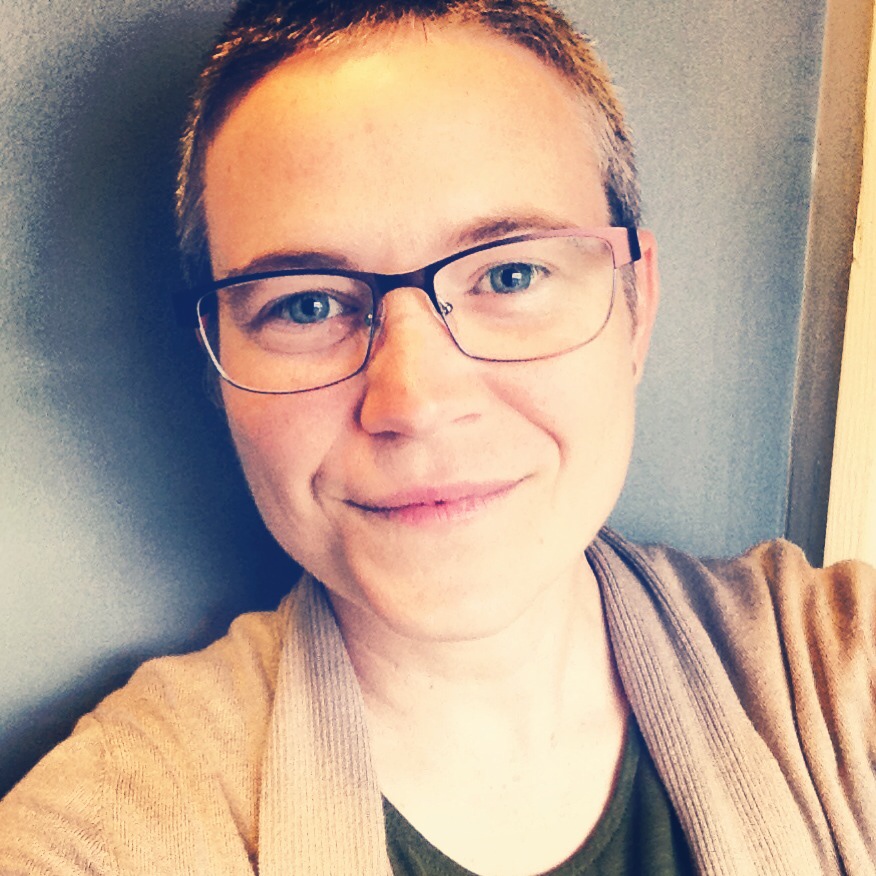
Photo of short-haired Alex wearing glasses and a straw-colored cardigan.

Kindly give us a short description of yourself and the work you do.

I write a zine called Alex, a perzine that’s loosely themed around gender identity. I also started up a small distro called Sleeping Creatures. I wish I could say I have a huge collection, but in reality, I’m building it really slowly. I guess I’m part of the Slow Zine Movement.

How did you get introduced to zines? Were you influenced by anyone?

I started writing zines way back in high school! I moved to a new school in 11th grade, and when making new friends joined a zine-making crowd. I loooooved making zines, and still credit the experience with introducing me to writing outside academic regurgitation, and also with helping me find my voice. I learned so much about myself through writing zines; I could explore my own thoughts and opinions, and also mess around with collage-making and craft. It was also amazingly empowering to trade zines at shows and meet penpals from around the country. To think my little zine had traveled so far… it was really confidence building.
What does it mean to do “feminist zine-making”? Does feminism appear in your work (explicitly or implicitly)?

When I read Alison Piepmeier’s book I was really struck by her definition of zine-making as practicing third-wave feminism. “Grrrl zines are coterminous with the third wave; grrrl zines and third wave feminism respond to the same world. Beyond sharing a historical moment with the third wave, grrrl zines are often the mechanism that third wave feminists use to articulate theory and create community.” (from the introduction to Girl Zines) It kind of blew my mind to read that because while I always saw my zines as feminist (because I wrote them, whether I explicitly engaged with feminist theory or not), I didn’t realize that zines played such a huge part in transmitting the message in the nineties, which is the time period she’s talking about. Actually it seems to me that Piepmeier is also saying that the message happened on the page—that it was being created and transmitted through the same vehicle. It’s pretty cool!

On QZAP’s collection policy statement page they talk about collecting queer zines that don’t address queer issues, that simply being queer makes your zine queer, an idea I agree with. And so it would be hard for me to sit down and parse out what makes my zines feminist, where do I say something that directly aligns with feminist ideology, because my whole framework is imbued with feminism. I guess I think it’s always there, in the same way I think that everything I do is queer.
What is your favorite zine or piece of mail art? Do you like any specific style/part of a zine?

I love a lot of zines. I have a thing for perzines that are honest, raw, and artsy. I like it when something’s happening on the page, visually. I’m into Pinch Kid at the moment, and picked up Volthair last year, a zine that excited me. Oh, and recently I’ve been reading “How to Sleep,” a zine so quirky and weird I totally love it.

If you could sum up your zinester life in a kitchen appliance, what appliance would it be?

This question really makes me laugh in the context of a feminist zine fest. Was that on purpose? Ok so here’s my answer: recently my relationship exploded, and somehow I insisted she should take the coffee grinder and I should get myself a new one. I don’t know why; I made a lot of weird decisions around that time. But burr grinders were too expensive so I bought a cheaper burr grinder where you grind the beans by hand. It seemed cool and I imagined it being like, “yeah, I milk my own cows” or some other DIY fantasy, but in fact it’s the worst thing ever. I wake up crazed and suffering from caffeine withdrawal and I have to sit there and HAND GRIND the beans for the love of god. Basically I think I answered the question, “what’s your most impractical kitchen appliance” but things that are difficult and impractical is a little like my zine-making process in a nutshell.

Finally, who are some of the other zinesters you’re excited to see at this year’s feminist zine fest?

OMG everyone.

Interview with a Zinester: Laura Lannes!

Laura Lannes, Brazilian zinester, is up next! Read on.

Drawn b&w self portrait of Laura with wavy hair put up and fading from dark at the top to disappearing into the white background at the bottom.

Kindly give us a short description of yourself and the work you do.

I’m a cartoonist and illustrator. I make comics about a lot of personal stuff, I guess, looking back now. I seem to do a lot of stuff about anxiety and depression, gender issues, weird feelings about my body.

How did you get introduced to zines? Were you influenced by anyone?

I first saw zines at a head shop near my house when I was in high school. They had a bunch of stuff about weed; some of them were comics. I was very into it. That’s when I started buying zines. In 2011 I made my first one and took it to a zine festival; that’s when I got in touch with zine culture. I’ve been influenced by a lot of cartoonists – zines have always been a staple of comics fests. I have a zine by amazing cartoonist Laerte that features a page on how to make zines (it’s in Portuguese because I’m from Brazil):

Comic created by Laura Lanne, written in Portuguese.
Comic created by Laerte, written in Portuguese.

What does it mean to do “feminist zine-making”? Does feminism appear in your work (explicitly or implicitly)?

Feminism is always on my mind. I think a lot about gender roles, particularly – why do I act a certain way, why is this “feminine” and this “masculine” etc. So that shows up in my work, not always subtly.

Considering the history of zines as a counterculture product, I think it’s a very well-suited medium for the self-expression of any group whose voice is silenced by the mainstream. I think this applies to women, and people of color, and feminists, and queer people, and so many other groups.

What is your favorite zine or piece of mail art? Do you like any specific style/part of a zine?

Eleanor Davis, one of my favorite artists, has a little one called “31 drawings that have something to do with being in love and not being in love.” It’s such a great little object. I also like one by a Brazilian cartoonist called Lovelove6 – all of her work is about feminism, and her first two zines were called (translation mine) “The ethics of horniness in post-modernity,” volumes 1 and 2.

If you could sum up your zinester life in a kitchen appliance, what appliance would it be?

Probably a deep fryer. I wish I was a vegetable steamer, but I know I’m a deep fryer.

Finally, who are some of the other zinesters you’re excited to see at this year’s feminist zine fest?

I like Annie Mok’s work, I was happy to see her name on the exhbitor list.

This is gonna seem biased because she’s my roommate, but, for real, Hazel Newlevant has great stuff that I love.

Interview with a Zinester: Hazel Newlevant!

We’ve got Hazel Newlevant’s interview up next! Check it out and find them on Tumblr as well.

Photo of a dark-haired zinester wearing a yellow cardigan and writing in a notebook.

Kindly give us a short description of yourself and the work you do.

I’m a Portland-raised, Queens-based cartoonist, and I make comics about things like queerness, relationships, music, and inequality—concurrent or consecutive! My comics tend to be “creative nonfiction,” either about the meaningful moments in my own life, or the lives of others that I find inspiring. My most recognizable work is If This Be Sin, a collection of comics about queer women and music. There’s a biography of the 1920s drag king Gladys Bentley, a profile of lesbian rockstars Wendy and Lisa (of Purple Rain fame), and story about a modern-day blues dance competition, based on my own experiences with social dancing.

How did you get introduced to zines? Were you influenced by anyone?

I first discovered zines when I was a teenager and worked at Reading Frenzy, a bookstore in Portland, OR. Local zine-makers were always coming in to consign their zines, so I read a lot of stuff on the job. I was really inspired by the mini-comics that people were drawing and printing themselves, and by the idea of making this perfect little pamphlet that’s just how you want it. Comics are my medium of choice, but as a reader, I’m interested in perzines, instructional zines, fanzines—the whole gamut.
What does it mean to do “feminist zine-making”? Does feminism appear in your work (explicitly or implicitly)?

I think feminist zine-making is about creating zines with an underlying consciousness about gender inequality and the unique challenges that women face. Zines are a powerful way for marginalized people to share their experiences and connect with others, and I’ve learned a ton by reading zines by women with disabilities, women of color, and women of different life experiences from my own in general.
What is your favorite zine or piece of mail art? Do you like any specific style/part of a zine?

That’s the most difficult question by far, when there’s so many to choose from! Some of my most favorite mini-comics include the series Zine City Comix by Kinoko Evans and Madtown High by Whit Taylor. Zine City Comix is about cute shamanic animal-beings interacting with technology, while Madtown High is about being a mixed-race kid going to high school in New Jersey. In many ways, they couldn’t be more different, but there’s a kindness and sincerity to both that I appreciate.

If you could sum up your zinester life in a kitchen appliance, what appliance would it be?

Food processor, turning the basil leaves of life into a delicious pesto.

Finally, who are some of the other zinesters you’re excited to see at this year’s feminist zine fest?

My buds Laura Lannes and Annie Mok will be at the zine fest, both of whom interrogate gender in interesting ways through their comics. I met the editors of From the Root when I was visiting Montreal, and I’m excited that they’re bringing their excellent WOC-focused literary journal to the US. The rest of the exhibitors are unfamiliar to me, so I’m looking forward to discovering everyone’s work!

Interview with a Zinester: Sarah Mangle!

Here we are with Sarah Mangle, a Montreal-based zinester that we’re happy to have coming to the fest! Check it out.

SarahManglePhoto
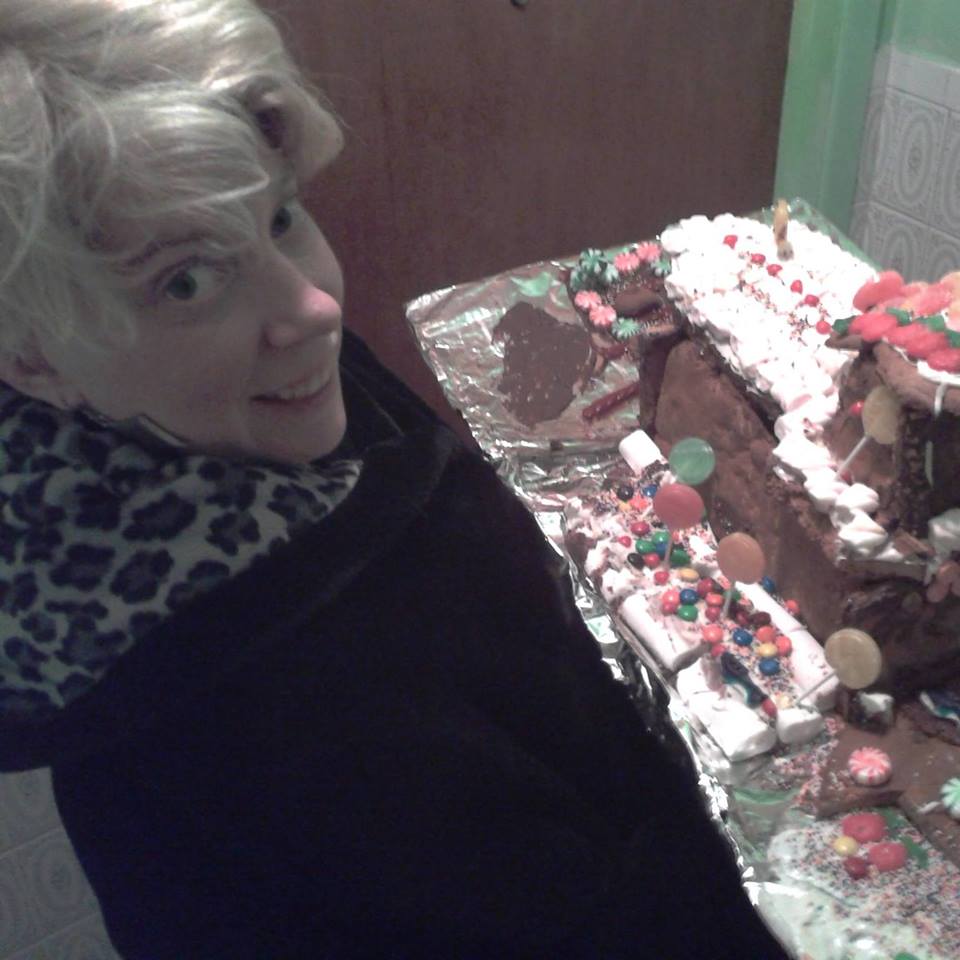
Blond zinester standing next to an elaborately decorated cake and looking up at the camera.

Kindly give us a short description of yourself and the work you do.

I am a 33 year old white queer artist and writer living in Montreal. I’m originally from Nova Scotia, and I was born in Pennsylvania. I work a variety of odd jobs to support my creative work: life drawing model, daycare teacher, English teacher, copy editor, and facilitator.

How did you get introduced to zines? Were you influenced by anyone?

The first zine I ever saw was a riot grrl style guerilla insert for “women’s” magazines in the 90’s, although at the time I didn’t know about riot grrl. You were supposed to go into corner stores and surreptitiously slip the inserts into magazines to help people who bought the magazines feel better about themselves. It was a project my social justice club had gotten their hands on and were distributing. I was in this social justice club in high school in Nova Scotia.

What does it mean to do “feminist zine-making”? Does feminism appear in your work (explicitly or implicitly)?

For me feminist zine making is zine making that is pro-sex work, anti-racist, pro-choice, trans-enthusiastic, supportive of live in caregivers and other temporary foreign workers. It is queer positive, it is honest, it is emotive, it is sensitive, it understands layers of survival, and embraces vulnerability and anger and sadness.

What is your favorite zine or piece of mail art? Do you like any specific style/part of a zine?

My favourite zine is When Language Runs Dry. That is a fucking beautiful project. Highly recommended. My preference for style changes, but I feel nostalgic about photocopies, typewriters and hand writing.

If you could sum up your zinester life in a kitchen appliance, what appliance would it be?

Spoon. I try to hold things. I try to savour them. I try to taste things.

Finally, who are some of the other zinesters you’re excited to see at this year’s feminist zine fest?

I’m particularly excited about Annie Mok and Sophie Labelle. I’m also excited to meet new friends!